Your bag

Guide
Are hand warmers safe?

What’s inside them, how they’re tested, and how to use hand warmers with confidence.
For something so small and simple, hand warmers raise surprisingly big questions.
Are they safe to hold for hours? Can they burn your skin? What exactly is inside them? Are the ingredients toxic? Are they safe for kids? Can you sleep with one?
They’re fair questions.
And strangely, most answers online tend to land at one of two extremes. Either the topic gets brushed aside with generic reassurance, or it gets framed through packaging warning language that can sound more alarming than it is helpful.
Neither really answers what people want to know.
So let’s start with the straightforward answer.
Yes — when used as directed, modern hand warmers are generally very safe.
They are well-understood products that have been used for decades by commuters, hikers, skiers, workers, anglers, athletes, and people who simply run cold.
That doesn’t mean they should be used carelessly. They generate heat, and any heat product deserves a little respect.
But the category itself is much less mysterious than people sometimes imagine.
In fact, understanding how hand warmers work usually makes them feel even more reassuring.
Why Hand Warmers Are Generally Considered Safe
One reason people sometimes overestimate the risk of hand warmers is because they picture something more volatile than what is actually happening.
But disposable air-activated hand warmers do not contain flames. They are not mini combustion devices. They do not rely on exposed heating elements.
They generate warmth through a controlled oxidation reaction inside a breathable pouch.
That distinction matters.
Because what’s happening is less dramatic than people assume.
A quality hand warmer is designed to release low, sustained warmth over time. Not sudden spikes of uncontrolled heat.
That is part of why the category has been trusted for so long.
Simple products, when well designed, often age well.
And hand warmers have.
What’s Actually Inside a Hand Warmer?
A lot of safety anxiety tends to disappear once people understand what they’re holding.
Most air-activated hand warmers use a straightforward blend of materials such as iron powder, water, salt, activated charcoal, and vermiculite.
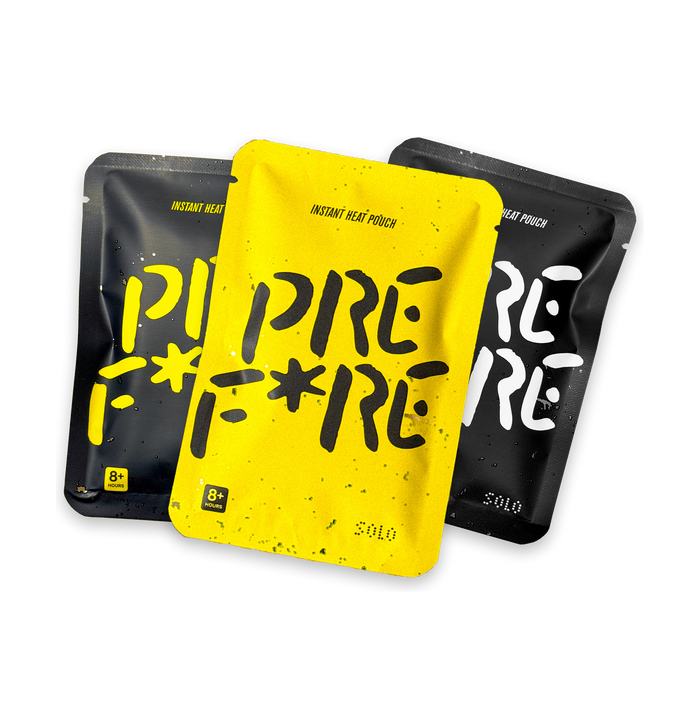
That same foundational chemistry is what powers PREFIRE.
Iron powder drives the oxidation reaction that creates warmth. Salt helps accelerate it. Activated charcoal helps distribute heat. Vermiculite helps retain it.
There is something reassuring in how ordinary those materials are.
Because despite how some people talk about “chemicals inside hand warmers,” the reality is much less exotic.
These are familiar materials working together in a contained system.
Simple ingredients. Powerful effect.
We’ve always liked that about the category.
Can Hand Warmers Burn You?
This is probably the biggest safety question people ask.
And the honest answer is nuanced.
Hand warmers are designed to provide comfortable warmth.
But like any heat source, prolonged direct exposure — especially against bare skin — can potentially cause irritation or injury.
That’s why product instructions often advise against prolonged direct skin contact.
That warning can sound dramatic when taken out of context.
But it is really just what responsible product labeling looks like.
It does not mean hand warmers are inherently dangerous.
It means heat products come with instructions.
Those are different things.
Most people use hand warmers in gloves, mitts, coat pockets, or layered clothing where warmth is buffered and comfortable.
That is generally how they’re intended to be used.
And it is where they tend to feel best.
Warmth near the body. Not pressed against skin for hours.
That’s a useful distinction.
Why Warning Labels Sometimes Sound Scarier Than Reality
This is worth talking about, because people often read warning language and infer the wrong thing.
Consumer products — especially those involving heat — often carry very conservative warnings.
That is legal caution and risk management doing its job.
Not necessarily a signal that everyday use is dangerous.
Those warnings often describe edge cases.
Not ordinary experience.
And confusing those two things can make a category seem riskier than it is.
It helps to keep that in proportion.
Yes, Hand Warmers Are Rigorously Tested
Another thing many people don’t realize is how much testing often sits behind a product this simple.
Quality hand warmers are generally evaluated not only for performance, but for consistency and safety under controlled conditions.
That can include testing in temperature-controlled rooms, monitoring thermal curves over time, simulating different environmental conditions, validating maximum surface temperatures, and measuring performance consistency across production runs.
Some testing looks specifically at the arc of warmth — how a product activates, where it peaks, how steady the plateau is, and how it tapers.
That matters.
Because good hand warmers are not simply designed to get hot.
They’re designed to produce warmth in a controlled and repeatable way.
That is a different challenge.
And honestly, a more interesting one.
At PREFIRE, we’ve always been interested in that distinction.
Not just whether warmth exists.
But how warmth behaves.
Because warmth should feel reliable. That includes safety.
Are The Ingredients Toxic?
Used as intended inside the sealed pouch, the materials in hand warmers are generally not something most users need to worry about.
They are part of a contained system.
If a pouch becomes damaged and contents spill, follow product instructions and avoid direct contact or ingestion, especially around children or pets.
But under normal use, those ingredients stay where they belong.
Inside the warmer.
And that tends to be far less dramatic than people sometimes imagine.
Are Hand Warmers Safe For Kids?
Generally yes, with supervision and according to instructions.
Families use hand warmers all the time for sledding, winter sports, outdoor events, and cold commutes.
The same commonsense principles apply.
Use them as directed. Use them in appropriate placements like gloves or pockets. Avoid prolonged direct skin contact. Supervise younger children.
Pretty intuitive.
And not very different from how most people already use them.
Can You Sleep With A Hand Warmer?
This is one area where extra caution makes sense.
Most manufacturers advise against sleeping with active hand warmers in direct contact with the body.
And that is reasonable.
When you are asleep, you are not adjusting for comfort or repositioning as you would when awake.
That changes the equation.
Some outdoor contexts may involve using warming products around sleeping systems in ways specifically intended for that use.
But as a general principle, direct-contact sleeping use is something to approach conservatively.
That’s simply good practice.
Are Hand Warmers Safe In Gloves And Pockets?
Yes.
And in many ways that is where they’re designed to live.
Inside gloves, mitts, pockets, or layered clothing is often where hand warmers perform best.
Insulation improves comfort. Warmth retention improves. And the product is being used as intended.
That’s the sweet spot.
Are Bigger Hand Warmers Less Safe?
People sometimes assume larger warmers must somehow be riskier.
Not really.
Larger warmers like PREFIRE ULTRA exist because greater material volume can support greater heat mass and longer duration.
That changes the performance profile.
It doesn’t suddenly make the product category unsafe.
It simply means choosing the right warmer for the use case matters.
Quick commute? One format.
All-day winter outing? Maybe another.
That is product fit.
Not danger.
What If A Hand Warmer Stops Working?
Usually nothing has gone wrong.
The reaction has simply finished.
That is exactly what is supposed to happen.
Unlike rechargeable devices, air-activated hand warmers are designed around a single-use heat reaction.
When the chemistry is done, the warmth fades.
That’s not failure.
That’s the product doing what it does.
What About Air Travel?
People ask this more than you’d think.
Most common disposable hand warmers are generally permitted in travel, though it’s always smart to verify current airline and regional rules.
But people bring them skiing, camping, and traveling constantly.
That tells you something.
The Bigger Safety Principle
There is a very simple framework here.
Treat hand warmers the way you’d treat any warmth source.
Use them intentionally. Follow instructions. Don’t overcomplicate it.
That gets you very far.
Most safety concerns start shrinking once the category is seen in proportion.
Hand warmers are not mysterious chemical pouches.
They are well-established warming products built around very simple principles.
That distinction matters.
So… Are Hand Warmers Safe?
Yes.
Used as directed, modern hand warmers are generally safe, widely trusted, and designed for reliable low-level warmth.
Like any heat product, proper use matters.
But for everyday intended use, they have earned their place for a reason.
They work. People trust them.
Usually those things travel together.
A PREFIRE Point Of View On Safety
We’ve always felt safety conversations are best when they rely on clarity, not fear.
Warmth should feel reassuring. Not complicated.
That has always shaped how we think about the category.
Simple ingredients. Thoughtful design. Reliable performance. Clear instructions.
That’s a strong foundation.
And honestly, one reason we love this humble little product category.
There is more intelligence in it than people tend to assume.